Saturday, August 31, 2013

WOM Recommendations: In A Nutshell


There are three types of word of mouth in terms of directionality:  positive (a recommendation), negative (advice against), and neutral.

Neutral, you ask?  Sure.  Imagine a friend telling you that a new bike rental stand will be set up outside your place of employment.  You drive a car and have no interest in riding a bike.  Well, that's your problem.  But you probably don't care one way or another about that piece of information your friend passed along to you (and which you might pass along to another friend at work who doesn't own a car) - it's neutral.  But from the marketer's perspective, that information could be disseminated through a relatively inexpensive advertising or direct marketing campaign.  What is interesting when it comes to efforts to leverage WOM is a positive recommendation.  And the following infographic neatly summarizes a few key points about it.


Thursday, August 1, 2013

So Much To Do and So Little Time

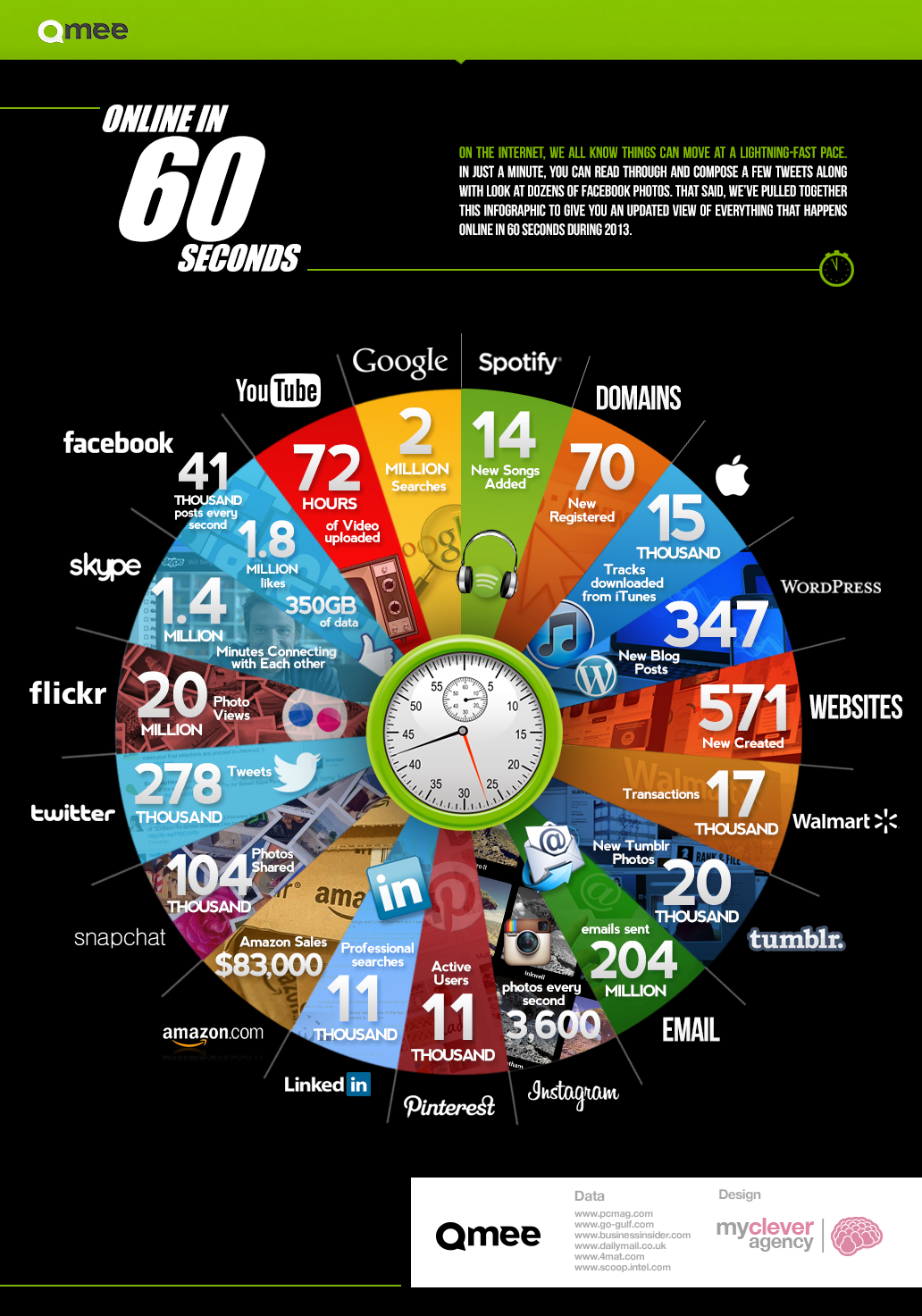
Someone's been using a stopwatch.  In case you missed this, here it is, in all its daunting glory: a breakdown of what happens online in 60 seconds relative to social media usage in 2013.

 By the way, by the age of 70, the average Frenchman has spent a total of 8 days of his life saying "Bonjour."  [click image to enlarge]


Saturday, July 27, 2013

Hide the Chocolate or Lose the Diet

There's nothing more counter-productive to not eating between meals than living with someone who leaves an open package of chocolate chip cookies or nacho chips on the kitchen counter.  There are two ways to deal with this situation: close the package and put it back on the shelf or reach in and snatch a couple cookies or a handful of chips.  Guess which action is more likely?  I rest my case.

A new study on self-control by researchers from the Universities of Cambridge and Dusseldorf adds credence to the scenario above by suggesting that avoiding temptation is likely to increase your chances of success with a diet as opposed to simply relying on willpower alone.  In other words, out of sight, out of mind.  According to one of the investigators, Molly Crockett, "Our research suggests that the most effective way to beat temptations is to avoid facing them in the first place."  True, this sounds like 'bubba psychology" - a truth that your grandmother could have told you, without having to do the research at all, but the research adds empirical support to what otherwise is armchair psychology.

The fancy term for restricting access to temptations is "precommitment" - such as not buying those fattening chocolate chip cookies in the first place or putting money is a savings account with high withdrawal fees. 

The research team provided male participants with a series of choices - some involving small rewards that were continuously available or large rewards that were forthcoming.  To obtain the large rewards, the participants had to exert willpower to resist opting for the small rewards.  For other choices they had the opportunity to precommit, so as to avoid the temptations.  Brain activity was measured as the decisions were made, and by looking at the brain regions that play a role in willpower and precommitment, it was found that precommitment was a more effective self-control strategy than willpower.  So give your brain a break and stick to your diet through some simple precommitments - don't buy the cookies, chocolates, or chips at all, or if you do, put them on a high shelf where you can't see them.  Hide the chocolate, save the diet.

Further reading:
Crockett, M. J., Breams, B. R., Clark, L., Tobler, P. N., Robbins, T. W., & Kalenscher, T.  (2013). Restricting temptations: Neural mechanisms of precommitment.  Neuron.  DOI: 10.1016/j.neuron.2013.05.028

Saturday, July 20, 2013

Avatars: You Really Can Go Back


According to recent estimates, more than 80 percent of Internet consumers and Fortune 500 companies have an avatar or presence in an online virtual community, including virtual worlds (e.g., Second Life) and social networks (e.g., Facebook).  In contemporary usage, “avatar” refers to general graphic representations that are personified by means of computer technology. Depending on the web site, an avatar may take the form of a static picture or a dynamic cartoonish character, with facial and body characteristics and style of dress chosen by the real-life user.  Internet users typically have some degree of choice as to the selection, modification, and accessorizing of a self-representational avatar, which can be constructed to represent one’s ideal or aspirational selves, or as a canvas for experimentation of various alternative selves, as MIT psychoanalyst Shelly Turkle observed in interviews with participants of virtual games:

                Online the plain represented themselves as glamorous, the old as young,
                the young as older.  Those of modest means wore elaborate jewelry.  In
                virtual space, the cripple walked without crutches, and the shy improved
                their chances as seducers.

As consumer behavior researcher Russell Belk observed, in the pre-digital era, new identities could be tested by changing one’s hair style or color, growing facial hair, changing one’s lipstick and eye coloring, buying new clothes or cars, and so on.  Part of the great appeal of avatars for consumers in the digital era is derived from the physical invisibility that can be maintained within virtual space, which offers a relatively safe environment for self-experimentation.  Richard Allan Bartle, one of the creators of the first virtual world, MUD, was one of the first to point out that avatars now facilitate this process online by “let[ting] you find out who you are by letting you be who you want to be,” without the concomitant risks that would be evident in the physical world, providing a “looking glass” not only for others, but for ourselves.  A good example of this is the Ditto designer eyeglasses website, which invites each visitor to create a 3-D video of his or her face via their computer webcam to virtually try on glasses.  In this way, online shoppers can “see” themselves in any pair of the site’s growing collection of designer eyewear.

 Researchers have begun to turn their attention to avatars.  In a post a couple weeks ago I mentioned the Milgram obedience experiments and the ethical implications of doing that sort of research in the contemporary era of institutional review boards, ethical guidelines, and increasing suspicions about deception and invasion of privacy.  Avatars, however, are proving to be a more ethical alternative to real people.  In other words, you can convince someone that they are administering painful electric shocks to a virtual research participant, but not a real one.  No surprise, there are even ethical implications in using avatars for this sort of research, such as the argument that if you desensitize people to aggressing against someone in the virtual world, they will be inured to doing the same in the real world.  

Now comes an intriguing set of studies from a research team led by Domma Banakou, Raphaela Groten, and Mel Slater from the Experimental Virtual Environments Lab for Neuroscience and Technology in Barcelona.  This is pretty complicated stuff, but the title of their recently published research paper in the Proceedings of the National Academy of Sciences tells it all: "Illusory ownership of a virtual child body causes overestimation of object sizes and implicit attitude changes"  And here's a pretty clear summary from the Beaming website:


Immersive virtual reality can give adults such a strong illusion of being inside a child’s body that it affects their perception of the physical sizes of objects as well as their personal attributes, according to a study. Mel Slater and colleagues use immersive virtual reality to give adults avatars. Half had the virtual body of a 4-year-old and the other half a scaled-down adult body, the same size as the child body. Participants viewed their virtual bodies, which moved in real-time determined by the participants’ movements, from a first person perspective. Both groups reported that they felt a sense of “ownership” over their virtual bodies and both overestimated the size of objects in the virtual environment. However, participants in the child bodies overestimated object size by a greater degree than participants in scaled-down adult bodies. The “children” were also far more likely to associate with child-like attributes than the “small adults.” The sense of body ownership and differences in perception disappeared when the authors used the same virtual bodies, but disassociated participants’ movements from their avatars. This study demonstrates that the type of avatar can influence people’s size perceptions and self-attributes, a result that has potential in various computer-based applications, the authors argue.


Maybe it's an exaggeration to say we can go back again, but this research has some interesting implications.  Altering people's bodily self-representation, for example, by having an adult 'occupy' the body of a child,' seems to have the effect on our system of reproducing the experience of the world 'as a child experiences it.'  It's easy to recognize the potential here for manufacturers and designers of products for children or adults.  The ability to occupy the 'body' of a virtual child could provide insight into children's experience and attitudes towards furniture, toys, clothing, etc.  The same holds true for other kinds of individuals, such as the obese and handicapped.

As we choose our self-representations in virtual reality settings, our behaviors might be influenced accordingly.  In other words, we don't only exert influence on our avatars--they also exert influence on us.

Further reading:
1. D. Banakou, R. Groten, M. Slater.  Illusory ownership of a virtual child body causes overestimation of object sizes and implicit attitude changes.   Proceedings of the National Academy of Sciences, 2013.  DOI: 10.1073/pnas.1306779110
2. Belk, R.  (2013).  Extended self in a digital world.  Journal of Consumer Research, in press.
3.  Slater, M., Antley, A., Davison, A. et al.(2006). A virtual reprise of the Stanley Milgram obedience experiments. http://www.plosone.org
4.  Also check out Sebastian Kuntz's comprehensive Slideshare presentation, Immersive Virtual Reality, at:  http://www.slideshare.net/SebKuntz/immersive-virtual-reality

Wednesday, July 10, 2013

New Trends in Consumer Technology: Stealth Wear

Now You See Me . . .

One aspect of the trend toward photo conversing that I didn't broach in my last post has to do with privacy issues, a big, fat, open can of worms pertaining to social media that most social media pundits would rather not have to deal with.  But threats to privacy comprise the dark underside of all the fun stuff - the content creating and sharing that we read and hear about every day.

Perhaps the one emerging technology that has aroused the most serious concerns related to photo and video sharing is the potential for unsolicited and unrevealed image taking by wearers of Google Glass --the head-mounted glasses that have the capacity to shoot video, take pictures, and broadcast what the wearer is seeing to the world by uploading the content to the Internet within seconds.  Just as legislation appears to be doomed to failure when it comes to regulating new technology that enables peer-to-peer file swapping, I imagine that lawmakers will experience even more difficulty controlling the use of wearable recording and sharing appliances.


Short of trying to reason with image thieves (as I sometimes do when I'm with a Facebook user who
pulls out his or her iPhone to catch me on camera - 'uhn uhn'), there is, however, an emerging alternative:  'stealth wear,' a term used to describe clothing and accessories designed to protect the wearer from detection and surveillance.  In short, stealth wear encompasses a number of products that provide a technological solution for offer individuals privacy, such as hoodies and cloaks that use reflective, metallic fabric that promise to reduce a person's thermal footprint.  Another is a purse that sports extra-bright LEDs that can be activated when in the presence of someone who is attempting to take an unwanted photo or video.  Developed by stealth wear pioneer Adam Harvey, a professor at the School of Visual Arts in New York, the effect of the lights-activated purse is to reduce an unwarranted photo to a washed-out blur (see image below).


Of course, this sort of product is the worst nightmare of paparazzi whose targets brandish such stealth devices.  On the other hand, I could never understand why stars and celebrities are so concerned about paparazzi in the first place - if you don't want your photo taken, don't be a damn celebrity.  As my fellow Baltimorean John Waters once pointed out, what's the point of being famous if you don't want people running after you all the time and invading your privacy?

To check out some other examples of Adam Harvey's stealth fashion, such as the 'anti-drone burqa' (below), be sure to visit his website.


Some other examples of stealth products include the following:

  • a visor fitted with LEDs that emit light capable of blinding some camera sensors and blurring the details of a wearer's nose and eyes  (National Institute of Informatics in Japan)
  • a lenscap accessory for people who do not want to be recorded while conversing with a Google Glass wearer, the latter of whom is asked to use the lens covering (vs. removing the glasses) so that no taping or photographing would occur during the interaction (Todd Blatt)
 More performance art than serious stealth wear examples are these urban camouflage creations by Japanese designer Aya Tsukioka - a skirt that camouflages the wearer as a soda machine and a  backpack that conceals a child behind something that mimics a Japanese-style fire hydrant:


Stealth wear innovators are currently encountering a marketing challenge in that high tech fashion of any kind has not yet caught on with consumers, be it stealth wear devices or tech-savvy haute couture, such as clothing embedded with illuminated lights.  One possible explanation for the mild level of enthusiasm for stealth wear is that many people just don't care all that much about their privacy, a point elaborated on by Frank Rich in one of his recent New York essays.  As Rich convincingly argued, 'spying is only spying when the subject doesn't want to be watched.'  And it seems that people are falling all over themselves posting photos of themselves and friends on social media, whether they are flattering or not.  When people stop caring about their privacy, they're in big trouble, whether they know it or not.


Now You Don't.